
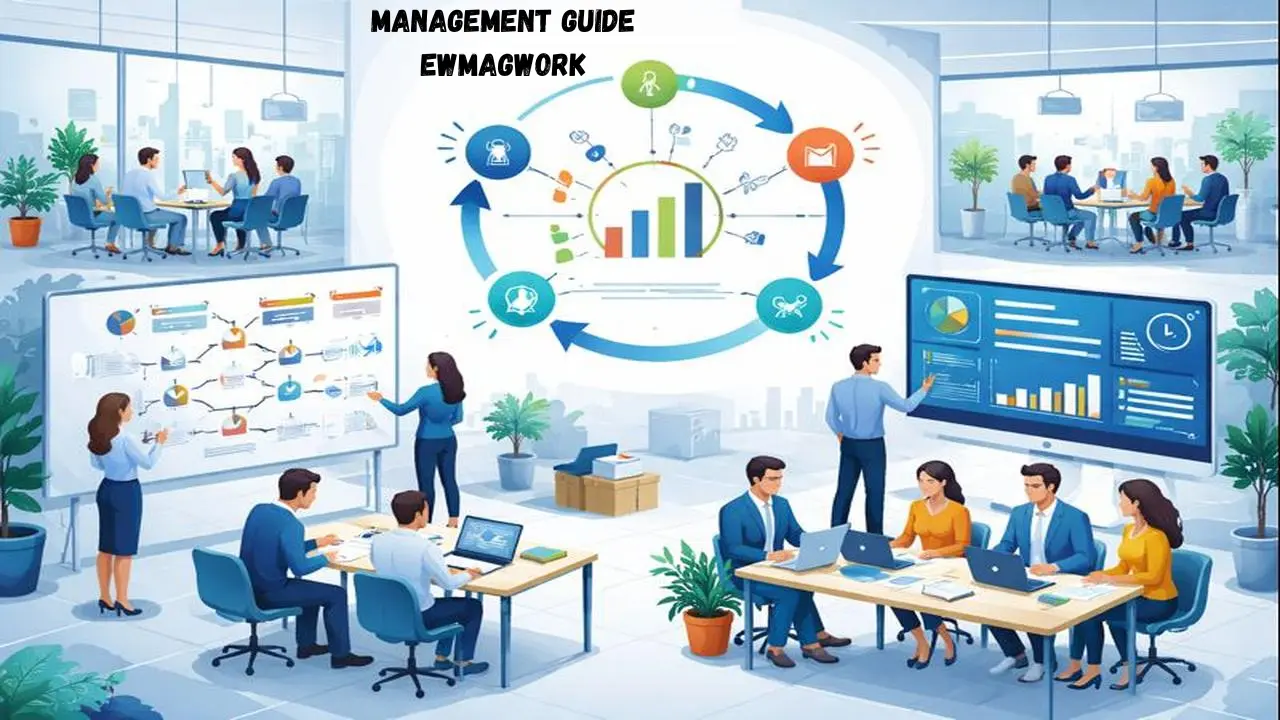
In today’s fast-moving professional environment, organizations need more than intuition to perform well. They require structured thinking, repeatable processes, and people-focused leadership that can adapt without losing direction. This is where the (Management Guide Ewmagwork) becomes a practical and valuable reference. Rather than being a rigid formula, it works as a flexible framework that helps managers understand how planning, execution, communication, and measurement fit together.
The purpose of this article is to provide a detailed, readable, and practical explanation of the management guide ewmagwork. The focus is on clarity and real-world application. Every organization, whether small or large, faces challenges such as misaligned goals, unclear roles, inefficient workflows, and inconsistent results. This guide addresses those challenges by organizing management principles into clear, actionable areas.
By the end of this article, you will understand how this framework supports better decision-making, improves team performance, and builds long-term stability. The tone remains practical, human, and grounded in everyday managerial realities.
Understanding the Core Philosophy Behind Ewmagwork
At its heart, ewmagwork is built on the idea that management is a system, not a set of isolated tasks. Decisions made in one area always affect another. For example, unclear goals often lead to poor execution, while weak communication can undermine even the best strategies.
The philosophy emphasizes balance. Strategy without execution creates frustration. Execution without strategy creates chaos. Ewmagwork connects these elements into a single management mindset where every action supports a broader purpose.
This philosophy also values people as much as processes. Systems exist to support human effort, not replace it. Managers using this framework focus on empowering teams, clarifying expectations, and creating conditions where consistent performance becomes possible.
Strategic Planning as the Foundation of Ewmagwork
Strategic planning is the starting point of the management guide ewmagwork. Without a clear direction, teams struggle to prioritize their efforts. Effective planning is not about creating long documents but about making intentional choices.
Good strategic planning answers three essential questions. Where are we now? Where do we want to go? How will we get there? These questions guide leaders in defining objectives that are realistic, measurable, and meaningful.
Planning within this framework also includes risk awareness. Anticipating obstacles allows organizations to respond calmly instead of reacting emotionally. When teams understand the strategy, their daily decisions become aligned with long-term goals.
Setting Clear and Measurable Objectives
Objectives give strategy a practical shape. In the ewmagwork approach, objectives must be specific enough to guide action while flexible enough to adapt to change. Vague goals create confusion, while overly rigid goals limit innovation.
Effective objectives focus on outcomes rather than activities. Instead of emphasizing how busy a team is, the focus shifts to what results are achieved. This clarity helps teams self-correct and take ownership of their performance.
Objectives should also be shared openly. When everyone understands what success looks like, collaboration improves and unnecessary conflict decreases.
Building Efficient Workflows That Support Teams
Workflows are the pathways through which work gets done. Poorly designed workflows waste time, energy, and motivation. The management guide ewmagwork treats workflow design as a strategic activity rather than an afterthought.
Efficient workflows are simple, transparent, and repeatable. Each step should have a clear purpose, owner, and expected outcome. Removing unnecessary steps often delivers faster improvements than adding new tools.
Another important element is feedback. Workflows should include natural checkpoints where teams can review progress and make adjustments. This means that handling problems early keeps them from growing bigger and causing serious difficulties later on.
Role Clarity and Responsibility Alignment
One of the most common causes of workplace tension is unclear responsibility. When people are unsure about who owns a task, work either gets duplicated or ignored. Ewmagwork places strong emphasis on role clarity.
Every role should answer three questions. What am I responsible for? What decisions can I make? Who do I collaborate with? Clear answers reduce hesitation and empower individuals to act confidently.
Responsibility alignment also supports accountability. When roles are defined, performance discussions become objective and fair. This builds trust between managers and teams over time.
Leadership Practices That Enable Sustainable Performance
Leadership within the management guide ewmagwork is not about authority alone. It is about influence, consistency, and example. Leaders set the emotional and operational tone of an organization.
Effective leaders communicate expectations clearly and listen actively. They understand that feedback is a two-way process. By creating a culture where people feel heard, leaders gain better insights into real challenges.
Consistency is another key leadership trait. Teams perform best when leadership behavior aligns with stated values. When leaders model discipline, respect, and accountability, those behaviors spread naturally across the organization.
Communication Systems That Reduce Friction
Communication failures are rarely about lack of information. More often, they stem from unclear channels, poor timing, or inconsistent messaging. Ewmagwork encourages structured communication systems that support clarity without overwhelming teams.
Effective communication systems define what needs to be shared, how often, and with whom. Regular updates prevent rumors and reduce uncertainty. At the same time, unnecessary meetings and messages are minimized.
Listening is treated as seriously as speaking. Managers who listen gain credibility and uncover problems early, before they affect performance.
Performance Measurement and Meaningful Metrics
Measurement plays a central role in the management guide ewmagwork. What gets measured influences what people focus on. Poor metrics encourage poor behavior, while meaningful metrics guide improvement.
The framework emphasizes a balance between quantitative and qualitative indicators. Numbers show what happened, but context explains why it happened. For example, productivity metrics are more useful when combined with quality and satisfaction insights.
Metrics should be reviewed regularly, not just collected. The purpose of measurement is learning, not blame. When teams view metrics as tools for growth, engagement increases.
Continuous Improvement as an Ongoing Habit
Improvement is not a one-time initiative. In ewmagwork, it is treated as a daily habit. Small, consistent improvements often deliver better results than large, infrequent changes.
Teams are encouraged to reflect on what worked, what did not, and why. These reflections create learning loops that strengthen processes over time. Mistakes are viewed as opportunities to improve systems rather than personal failures.
This approach also supports adaptability. Organizations that practice continuous improvement respond to change with confidence instead of resistance.
Managing Change Without Disrupting Stability
Change is inevitable, but chaos is not. The management guide ewmagwork offers a structured approach to change that protects core operations while allowing growth.
Change begins with clarity. People need to understand why change is happening and how it affects them. Transparent communication reduces fear and speculation.
Gradual implementation is another principle. Testing changes on a small scale allows organizations to learn and adjust before wider rollout. This protects stability while encouraging innovation.
Developing Team Capability and Skills
Skills development is an investment, not an expense. Ewmagwork encourages managers to view learning as a strategic priority. Skilled teams solve problems faster and require less supervision.
Development does not always require formal training. Coaching, mentoring, and peer learning are equally valuable. Managers play a key role by identifying strengths and supporting growth opportunities.
Over time, a focus on capability building creates resilience. Teams become more adaptable and confident in handling new challenges.
Decision-Making Frameworks That Support Consistency
Good decisions depend on good frameworks. Ewmagwork promotes structured decision-making that balances data, experience, and judgment.
Clear decision rights prevent delays. When people know who decides what, execution becomes faster and more confident. This reduces frustration and second-guessing.
Decisions are also documented when appropriate. This creates learning records that help teams understand past reasoning and improve future choices.
Aligning Culture With Operational Goals
Culture shapes behavior even when no one is watching. In the management guide ewmagwork, culture is treated as a management responsibility, not an abstract concept.
Values must be reflected in daily actions. Recognition, feedback, and consequences all communicate what truly matters. When culture aligns with operational goals, performance becomes sustainable.
Managers influence culture through consistency. Small actions repeated over time shape norms more powerfully than slogans or statements.
Technology as a Support Tool, Not a Solution
Technology can enhance efficiency, but it cannot fix poor management. Ewmagwork views tools as enablers rather than solutions. Processes and roles must be clear before technology is introduced.
Choosing the right tools involves understanding actual needs. Simplicity is often more effective than complexity. Tools should reduce friction, not create new obstacles.
Ongoing evaluation ensures that technology continues to serve its purpose as the organization evolves.
Integrating the Management Guide Ewmagwork Into Daily Operations
The real value of the management guide ewmagwork lies in integration. It is not meant to sit on a shelf but to guide everyday decisions and behaviors.
Managers can begin by assessing current practices against the framework. Small adjustments, such as clarifying roles or improving communication routines, often deliver immediate benefits.
Over time, consistent application builds alignment. Teams understand expectations, leaders act with confidence, and performance becomes more predictable and sustainable.
Long-Term Benefits of Applying Ewmagwork Principles
Organizations that apply ewmagwork principles consistently experience several long-term benefits. These include improved clarity, stronger collaboration, and better resilience during change.
Employees feel more engaged when systems support their efforts. Managers spend less time firefighting and more time guiding growth. Customers and stakeholders benefit from consistent delivery and quality.
Most importantly, the organization develops a shared management language. This common understanding reduces friction and supports collective success.
Conclusion Why the Management Guide Ewmagwork Matters
Management is often described as both an art and a discipline. The management guide ewmagwork respects this balance by offering structure without rigidity. It recognizes that people, processes, and goals must work together to create meaningful results.
By focusing on clarity, consistency, and continuous improvement, this framework helps organizations move from reactive management to intentional leadership. Its strength lies in practicality and adaptability.
For managers seeking a reliable reference to guide daily actions and long-term decisions, this approach provides a solid foundation for sustainable success.
Frequently Asked Questions
1. What is the main purpose of the management guide ewmagwork?
The main purpose is to provide a structured yet flexible framework that helps managers align strategy, people, and processes for consistent performance.
2. Can the management guide ewmagwork be applied to small teams?
Yes, the principles are scalable and work effectively for small teams as well as larger organizations.
3. How does ewmagwork improve team accountability?
By clarifying roles, responsibilities, and objectives, it creates transparency and fair accountability across teams.
4. Is this framework suitable for fast-changing environments?
Yes, its emphasis on continuous improvement and structured change makes it well-suited for dynamic environments.
5. How long does it take to see results from ewmagwork?
Some improvements, such as better communication and role clarity, can be seen quickly, while deeper cultural benefits develop over time.
Read More: Dunzercino Explained Meaning Concept Uses and Future Potential
About the Author